


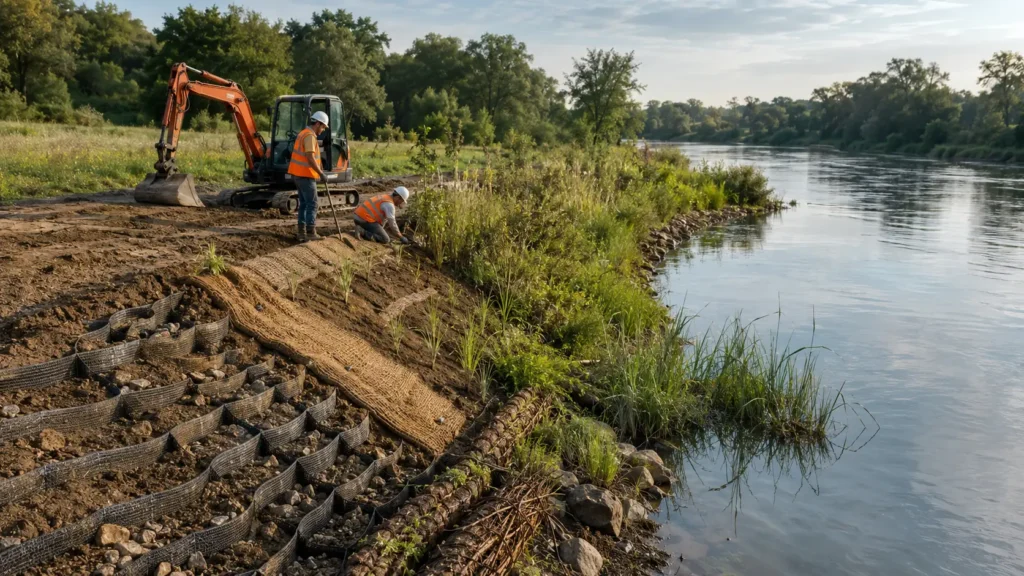
The banks of rivers, canals, reservoirs and lakes are ecological and hydraulic interfaces of major importance. Constantly exposed to natural forces – changes in flow, wash from passing vessels, scour, alternating submersion and exposure – they are at permanent risk of deterioration. Bank protection works are now essential to prevent erosion, secure riverside infrastructure and preserve aquatic and terrestrial biodiversity.
For local authorities, civil engineering consultants, contractors and landscape architects, designing and delivering riverbank stabilisation projects raises complex challenges. How can a structure remain mechanically stable under hydraulic loading while limiting settlement on marshy or low-bearing soils? How can strict hydraulic engineering requirements be reconciled with protection of the natural environment?
In this article, we look at the main constraints of bank protection and the limits of conventional methods. We then explain the added value of lightweight polypropylene honeycomb fill, which reduces loads without ruling out planting.
Why has riverbank stabilisation become a major issue?
Bank works address major environmental, safety and economic issues. With more extreme weather, more frequent floods and increasing human activity along watercourses, the management of river and lake margins calls for appropriate technical solutions.
Risks linked to hydraulic erosion and slope failure
Under the constant action of currents, boat wash and surface water run-off, the soil forming the bank is gradually destabilised and carried away. Bank erosion leads to:
- Scour at the toe of the bank, causing whole sections of ground to collapse;
- Local and global slope failures, directly endangering roads, buildings, drainage networks and nearby structures;
- Sediment entering the watercourse, degrading water quality and disrupting flow;
- Failures during rapid drawdown: water held in the slope exerts pore pressure once the external water pressure has gone.
Where the founding soils are weak or compressible (peat, clay or silt), the weight of conventional fill (1,800 to 2,000 kg/m³ on average) increases the risk of sinking and of global instability of the bank.
Reconciling engineering constraints and ecosystem protection
Historically, erosion was often treated with purely rigid, hard-engineered solutions. Today, environmental legislation – in Europe, notably the Water Framework Directive – requires the ecological continuity of watercourses and the natural functioning of wetlands to be maintained. Depending on the country, bank works may require consent from the environmental or flood-risk authorities.
Modern river engineering therefore faces a dual challenge:
- Ensuring the long-term structural stability of the bank under mechanical and hydraulic loading;
- Encouraging revegetation and permeability, which are vital for the bank’s role as an ecological buffer and natural filter.
What are the main riverbank stabilisation techniques?
Bank engineering offers a wide range of methods, from heavy civil engineering to purely vegetative techniques. Each approach has its own technical characteristics and limits, to be assessed before any project.
1. Conventional hard engineering: rock armour, gabions and concrete
Hard engineering creates massive mineral protection:
- Rock armour (rip-rap), loose or grouted: heavy rock placed at the toe or over the whole slope.
- Gabions: steel mesh baskets filled with stone.
- Concrete retaining walls or steel sheet piles: the fill placed behind these structures loads the tie rods and foundations.
Advantages: high immediate resistance to strong flows and wave action.
Limitations:
- Considerable loads on the founding soil, with a risk of differential settlement on compressible ground.
- Heavy visual and ecological impact (artificial banks, broken ecological corridors, no vegetation).
- High transport and handling costs due to the mass of materials.
2. Soil bioengineering: fascines, wattle fencing and biodegradable geotextiles
Soil bioengineering relies on the stabilising effect of roots and plant biomass (willow, emergent wetland plants, coir geotextiles) to hold the soil in place.
Advantages: excellent landscape integration, low environmental footprint and biodiversity gains.
Limitations:
- Delayed effectiveness: full protection is only reached once the root system is established.
- Greater vulnerability to major floods immediately after installation.
- Limited bearing capacity: unable to support heavy loads or large volumes of fill at the top of the bank.
3. Combined techniques: toe protection and lightweight fill
To overcome the trade-off between the rigidity of concrete and the initial fragility of vegetation, projects often combine toe protection (rock armour or bioengineering) with lightweight fill in the body or at the top of the bank.
Lightweight fill replaces heavy fill behind a retaining structure or beneath a footpath. It is covered with topsoil, which can be planted. Designers can therefore reduce loads without overloading sensitive soils.
Nidaplast RA: lightweight, hydraulically transparent fill for riverbanks
French manufacturer Nidaplast, based in northern France, produces Nidaplast RA, a honeycomb lightweight fill used on compressible ground, against structures and in wetlands.
In riverbank projects, Nidaplast RA blocks (grades RA 400, RA 500 and RA 600) provide practical answers to load, erosion and drainage challenges.
How it works: the polypropylene honeycomb
The honeycomb structure has a void ratio of 95%. Made of extruded polypropylene (60% recycled content) with a thermally bonded non-woven geotextile on each face, the blocks are rot-proof and hydrocarbon-resistant. They behave as a rigid cellular structure with a vertical compressive strength of 300 to 500 kPa (short term, 520 mm block) and an extremely low density of 35, 40 or 45 kg/m³ for grades RA 400, 500 and 600 respectively.
Benefit 1: exceptional lightness for low-bearing soils
One of the main obstacles in earth retention or bank repair is the self-weight of conventional materials: compacted soil or granular fill weighs on average 1,800 to 2,000 kg/m³. On compressible ground, these loads create a risk of sinking and bearing failure.
Using Nidaplast honeycomb blocks as lightweight fill:
- For the same volume, the fill is up to 50 times lighter than conventional mineral fill.
- Settlement is limited and the driving force behind slope failure is reduced.
- The solution is suitable for silts, peat and marshland, subject to a stability check by the design engineer
Benefit 2: mechanical strength and control of hydraulic pressures
Nidaplast RA blocks can carry a permanent load of 45 to 85 kPa depending on the grade (safety factor of 2, extrapolated over 50 years), i.e. up to 2.30 to 4.30 m of fill above the blocks (maximum values for 3 layers, to be confirmed by design). With 95% voids, water flows through the cells: there is no sealed volume subject to buoyancy, and the geotextile retains fines. The blocks do not alter flow conditions during floods: Nidaplast RA is a hydraulically transparent fill.
Run-off and groundwater flow freely through the free-draining fill, which limits uplift pressures during drawdown – a frequent cause of bank failure.
Benefit 3: easy installation, compatible with soil bioengineering
In addition to their mechanical performance, Nidaplast solutions are easy to install on site:
- Easy handling: at 53 to 67 kg per 2.40 × 1.20 × 0.52 m block, they are installed without heavy lifting equipment (observed rates of up to 100 m³ per operative per day), reducing site costs and the carbon footprint of the works.
- Made-to-measure: blocks can be cut with a chainsaw or excavator bucket, and RA 500 panels from 40 to 120 mm thick allow level adjustments to follow the complex shapes of rivers and ponds.
- Ecological compatibility: Nidaplast blocks can be combined with geotextiles, topsoil and soil bioengineering techniques (live cuttings, geogrids, pre-planted mats). Vegetation roots in the topsoil cover. The block mass is wrapped in geotextile and protected at the sides and against UV.
Planning a riverbank project?
Key steps for a successful riverbank stabilisation project
To ensure the durability of bank protection works, the project must follow a rigorous methodology.
1. Ground investigation and hydraulic design
Before any works, a geotechnical and hydraulic assessment is essential to determine:
- The type and bearing capacity of the founding soil;
- Flow velocities and design flood levels (for example the 1-in-100-year flood);
- Imposed loads at the top of the bank (footpaths, maintenance vehicles, landscaping);
- The permits required under local water and flood-risk regulations.
The design engineers will then determine the required thickness of honeycomb fill and any anchorage needed.
2. Installation tailored to each bank
Installing Nidaplast RA is quick: the blocks are light, easy to cut on site and require no compaction. Only the cover layer is compacted. The block mass is wrapped in geotextile and then covered with topsoil.
One point is essential: the toe of the bank must be protected against scour, with rock armour, gabions or soil bioengineering. The blocks must never be directly exposed to the current.
The bank profile, the cover thickness and the choice of grade (RA 400, RA 500 or RA 600) depend on each project. Our technical design team will help you define the right installation method for your site.
3. Finishing: planting and landscape integration
Once covered with topsoil, the bank can be seeded or planted: seed mixes suited to wetlands, emergent wetland plants (reeds, yellow flag iris) at the toe, and deep-rooting shrubs at the top of the slope.
The result combines a green riverbank with an invisible lightweight fill that durably reduces loads on the ground and on structures.


