


Polypropylene honeycomb fill — dam spillway rehabilitation, Derbyshire (UK)
To secure Toddbrook Reservoir (Derbyshire, UK) for the long term, 240 m³ of Nidaplast RA600 polypropylene honeycomb lightweight fill were installed in the new side spillway.
Specified by ARUP for Canal & River Trust, this lightweight backfill solution was chosen to reduce lateral earth pressure on the reinforced concrete spillway walls while delivering proven performance in permanently saturated ground — a context where conventional granular backfill and EPS geofoam both present unacceptable structural risks.
240 m³
lightweight fill
6
layers of cellular blocks
2025
construction year
Toddbrook Reservoir: Dam Rehabilitation Context and Structural Challenge
In August 2019, severe rainfall caused major damage to the auxiliary spillway of Toddbrook Reservoir, a dam in the Peak District, Derbyshire.
The incident triggered the emergency evacuation of 1,500 residents from Whaley Bridge to prevent catastrophic failure downstream. I
nvestigations confirmed that the existing structure, despite meeting legal requirements, had deteriorated over time and had inherent design deficiencies.
Canal & River Trust undertook a large-scale structural rehabilitation programme, including construction of a new 200-metre side spillway — one of the most technically demanding dam rehabilitation projects in the UK in recent years.
The key challenge: finding a backfill material that could perform reliably in permanently saturated ground without generating buoyancy forces or lateral overpressures.
What ARUP Required from the Dam Spillway Backfill
ARUP’s technical specification for the spillway backfill imposed four non-negotiable constraints:
- Reduce lateral and vertical pressures on the reinforced concrete spillway walls.
- Limit overall structural loads in the immediate vicinity of the dam.
- Provide a fill solution fully compatible with permanently saturated ground — zero buoyancy risk under any reservoir operating condition.
- Enable rapid, safe installation to meet a demanding rehabilitation programme.
Conventional granular backfill was ruled out: lateral earth pressure too high.
EPS geofoam was ruled out: buoyancy forces in a permanently saturated environment make it structurally unsafe for a dam application.
Nidaplast RA600 was specified as the only engineered lightweight fill meeting all four constraints simultaneously.
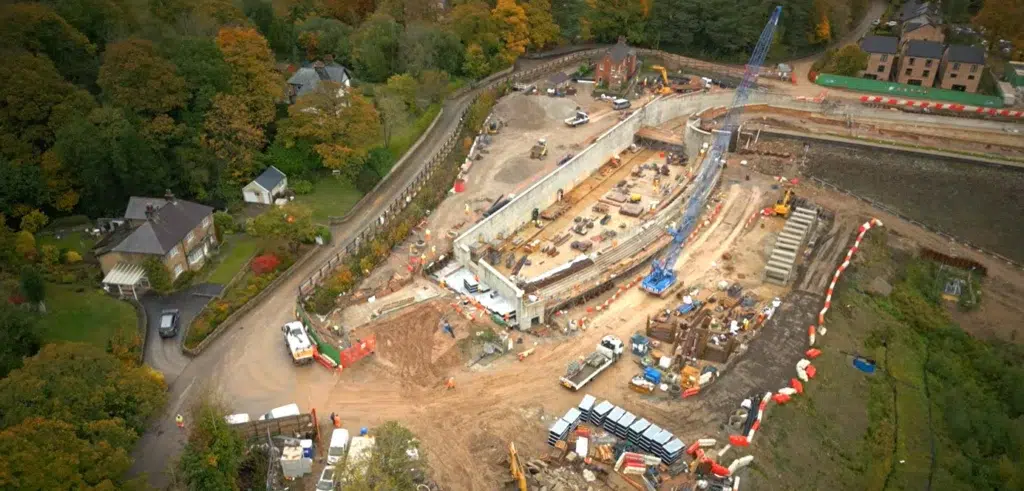
Nidaplast RA: lightweight fill solution implemented in a wetland environment
Nidaplast RA600: high-performance lightweight fill for hydraulic applications
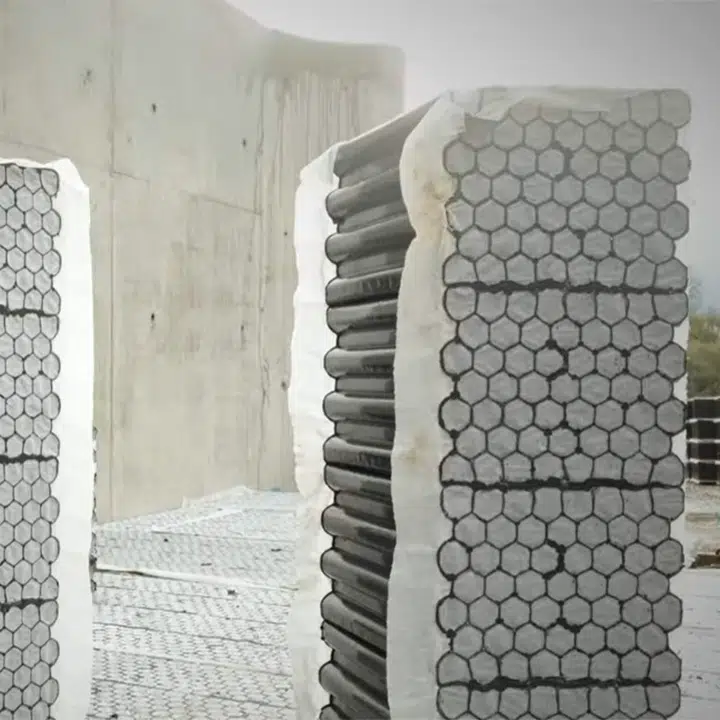
Nidaplast RA600 is an ultra-lightweight cellular fill made from extruded polypropylene (PP), with a 95% void ratio.
At 45 kg/m³ dry unit weight, it replaces conventional heavy backfill (approximately 1,800–2,000 kg/m³) with a solution that is 40 to 50 times lighter — dramatically reducing the lateral earth pressure on the spillway wall.
- Lightweight Fill Without Buoyancy Risk: the Decisive Advantage in Saturated Ground
Unlike EPS geofoam, which generates significant uplift forces when submerged and requires complex anchoring systems to resist flotation, the rigid open-cell hexagonal structure of Nidaplast RA allows water to circulate freely through the fill.
The material is not subject to buoyancy forces under any groundwater or flood condition — no uplift, no displacement, no loss of performance.
Nidaplast RA600 is the only lightweight fill qualifying as a hydraulically transparent fill: a property exclusive to open-cell polypropylene honeycomb structures and a critical requirement for any dam, spillway or flood zone application.
This makes it the engineered EPS-alternative water-resistant fill of choice for hydraulic structures. - High Compressive Strength for Long-Term Dam Structural Performance
The RA600 grade provides the highest mechanical performance in the Nidaplast RA range: long-term allowable compressive strength of 85 kPa (8.5 t/m²), with a safety factor of 2 applied over a 50-year design life (per CSTB Technical Approval).
This ensures permanent protection of the spillway walls against lateral overpressure throughout the dam’s full service life. - On-Site Adaptability to Complex Spillway Geometry
Blocks were cut on site using a chainsaw at the panel joints to match the irregular geometry of the spillway structure precisely — essential on a bespoke rehabilitation project where no two sections follow a standard profile.
Technical characteristics of Nidaplast RA600 lightweight fill
Block dimensions:
2400 x 1200 mm.
Block height:
520 mm.
Bulk density:
45 kg/m³.
Material:
100% recyclable polypropylene


Nidaplast RA
Nidaplast RA lightweight embankments are extremely light and resistant. These honeycomb structures are the recommended solution for constructing landscape embankments, road embankments, or building embankments.
View product sheetLightweight fill installation in wet conditions: construction stages
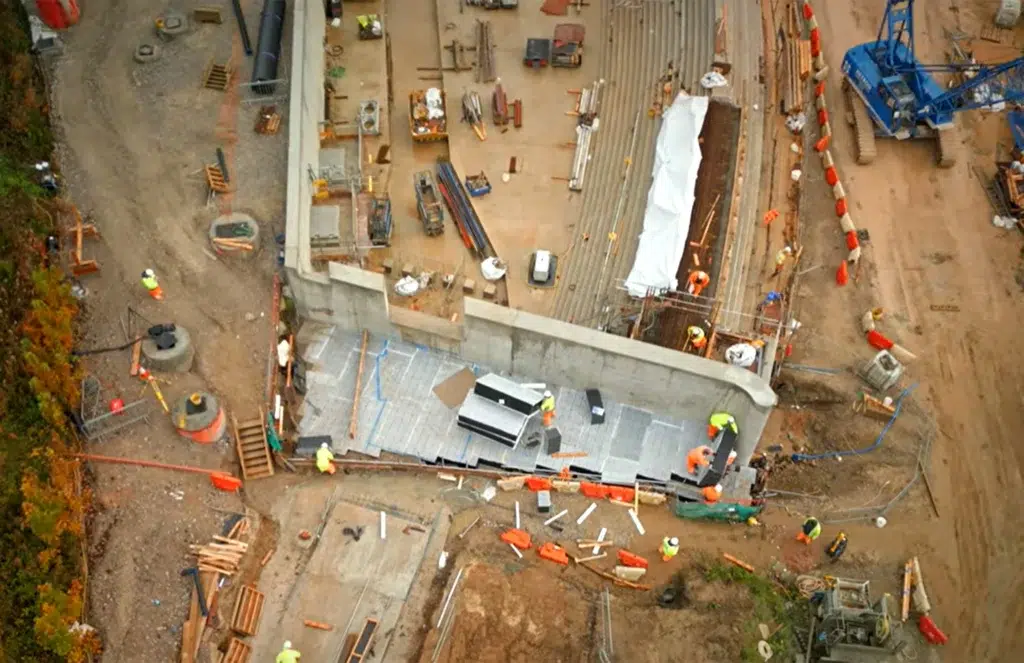
The installation of 160 cellular blocks was optimised to ensure uniform mechanical behaviour across the entire structure.
1. Preparation
Delivery and inspection of the blocks, followed by installation of a 300 g/m² anti-contamination geotextile to isolate the lightweight fill from the foundation ground.
2. Block installation
Six successive layers with staggered cross joints to maximise inter-block stability and lateral load distribution across the spillway wall.
3. Adjustments
On-site cutting — precision chainsaw cutting at the panel joints to adapt blocks to the irregular spillway geometry; no specialist plant required.
4. Final works
Level verification, geotextile closure over the top face, and final backfilling above the lightweight fill mass.
Watch the video
Results: safety, efficiency and performance of the lightweight fill
The Nidaplast RA600 lightweight fill solution at Toddbrook dam spillway delivers the following verified outcomes:
- Improved safety for downstream communities: a stable, durable spillway structure under all reservoir operating conditions.
- Long-term protection of the reinforced concrete spillway walls against lateral earth overpressure.
- Reliable performance in permanently saturated ground: zero buoyancy, zero performance loss during reservoir level fluctuations or flood events — the only EPS-alternative water-resistant fill validated on a live dam by an independent engineering firm (ARUP).
- Optimised construction programme: lightweight, manually handled blocks eliminated the need for heavy plant on a sensitive rehabilitation site.

Working on a dam, spillway or flood zone project?
Do you need a lightweight backfill for saturated or high groundwater conditions?


