On-site stormwater management is now a baseline requirement for most development projects across Europe. Whether the brief is a retail car park, a council facility, a business park or a residential scheme, designers and procurement teams are looking for surface systems that combine long-term permeability, structural durability and landscape integration.Conventional pervious block paving is a familiar answer. But higher-performance systems — notably the OCITY PAV65 cellular paving slab — now make it possible to go further. Here are ten representative project types and what each one demands technically.
1. Retail Car Park (Supermarket or Retail Park)
Retail car parks are among the most demanding applications for permeable paving. High vehicle throughput, repeated turning movements, and delivery vehicle access to designated zones generate the full range of structural and hydraulic stresses a surface system must withstand.
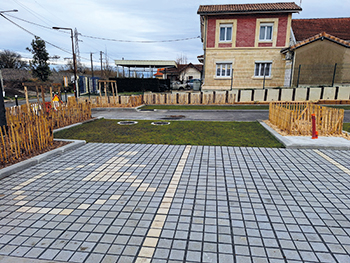
The cellular slab system is particularly well suited to the light vehicle zones of retail car parks, where permeability must be maintained over time despite continuous traffic loading. The OCITY PAV65 allows bay zoning — disabled bays, family bays, EV charging bays — to be integrated through differentiated paver colours, without breaking surface continuity or requiring painted markings that degrade over time.
A minimum subgrade bearing capacity of 50 MPa before installation is required to guarantee long-term structural integrity.

2. Council Car Park (Town Hall, School, Public Facility)
For local authorities, the selection criteria go beyond hydraulic performance. Budget control, maintenance minimisation and compliance with drainage strategy requirements are equally decisive.
The OCITY PAV65 offers a directly relevant advantage here: its permeability is structural rather than joint-dependent, which means hydraulic performance remains stable over time without joint cleaning operations. This translates into lower whole-life maintenance costs compared with conventional pervious block paving — a meaningful difference over the 20- to 30-year design life typical of public infrastructure.
Find out why councils across Europe are specifying this system
3. Business Park or Commercial Campus
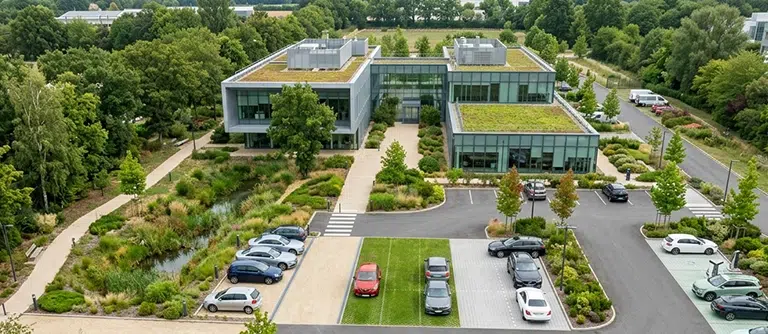
Business parks are increasingly integrating permeable car parks into their environmental credentials — BREEAM, LEED and other sustainability certification schemes award points for on-site stormwater management and permeable surface coverage.
The OCITY PAV65, combined with a permeable subgrade and a crushed aggregate sub-base (2/32 or 2/20 grading), delivers full on-site infiltration — eliminating or substantially reducing the need for downstream attenuation basins. For projects with strong landscape requirements, combining the PAV65 with the NGR65 grass slab creates grassed transition zones within the same surface plane.
4. Landscaped Car Park (Country Park, Nature Reserve, Tourist Site)
Natural and heritage sites typically impose strong landscape integration requirements. Hard grey surfaces are incompatible with the setting; the surface system must recede into the landscape.
Cellular paving slabs allow locally sourced natural stone (limestone, granite, sandstone, cut to 150 × 150 mm) to be used in the PAV65 slab. The stone itself need not be permeable — permeability is delivered by the slab structure, not the paving unit material. This makes it possible to meet heritage and conservation requirements without compromise on hydraulic performance.
5. Campsite or Outdoor Leisure Facility
Campsites and outdoor leisure facilities are frequently located in environmentally sensitive areas — near watercourses, on naturally permeable soils, within or adjacent to protected zones. Stormwater management at source is often a condition of planning permission.
The PAV65 slab offers reliable performance across seasonal and climatic variation, with immediate load-bearing capacity on installation. In shaded or wooded settings, peripheral infiltration continues to function even where biological growth develops on paving unit surfaces — a common limitation of joint-dependent pervious systems in tree canopy conditions.
6. Motorhome and Large Vehicle Parking Area
Motorhome parking areas represent a specific structural case: sustained static loads from vehicles between 3.5 and 7 tonnes, combined with slow turning movements at low speed.
The OCITY PAV65 is dimensioned for light vehicle use. For motorhome and heavy vehicle applications, thorough geotechnical validation of the subgrade (bearing capacity above 50 MPa) and careful sub-base design are essential before specifying this system. A geotechnical engineer should sign off the structure before construction commences for this category of use.
7. Residential Car Park (Housing Development, Apartment Block)
Planning policy across Europe increasingly requires on-site stormwater management for new residential development. Permeable parking surfaces are one of the most practical ways to meet this requirement within a residential plot.
The PAV65 slab allows residential car parks to be built with a concrete or natural stone paving finish — visually consistent with the wider development — while meeting permeability requirements. A standard bay layout (2.5 m × 5 m) is achievable with minimal slab cutting. The surface is available for use immediately after installation, without a curing period.
8. Historic Town Centre or Conservation Area
In historic centres and conservation areas, surface materials are frequently prescribed by planning authorities or conservation officers. Standard grey block paving is often rejected; the surface must match the established character of the streetscape.
The PAV65 slab accepts natural stone paving units (limestone, granite, sandstone) to 150 × 150 × 60 mm with chamfered edges and without spacers — meeting the material requirements typically imposed in conservation areas while delivering the hydraulic performance required by the drainage strategy.

9. Mixed Pedestrian and Vehicle Car Park
Town centre and village car parks often need to accommodate both vehicle circulation and pedestrian desire lines within the same surface. The PAV65 profile (65 mm total depth, level surface finish) is fully compatible with pedestrian accessibility requirements and level-access routes.
The paving layout can be adapted to visually define pedestrian circulation zones and parking bays within a single coherent surface — without level changes or trip hazards.
10. Zoned Car Park (Disabled Bays, Family Bays, EV Charging)
The OCITY PAV65 system allows differentiated zoning within a single car park surface through paver colour selection: disabled bays, family bays and EV charging spaces can all be marked using paving units in contrasting colours, fully integrated into the surface without painted markings.
This approach is durable — paver colour does not fade — and accessible, providing clear visual differentiation that meets the requirements of accessibility standards without surface interruption.
What These Examples Have in Common
Across all ten project types, hydraulic performance depends less on the paving unit itself than on the complete build-up:
subgrade permeability and bearing capacity, draining sub-base, bedding course specification, and the system that holds the paving units in place.
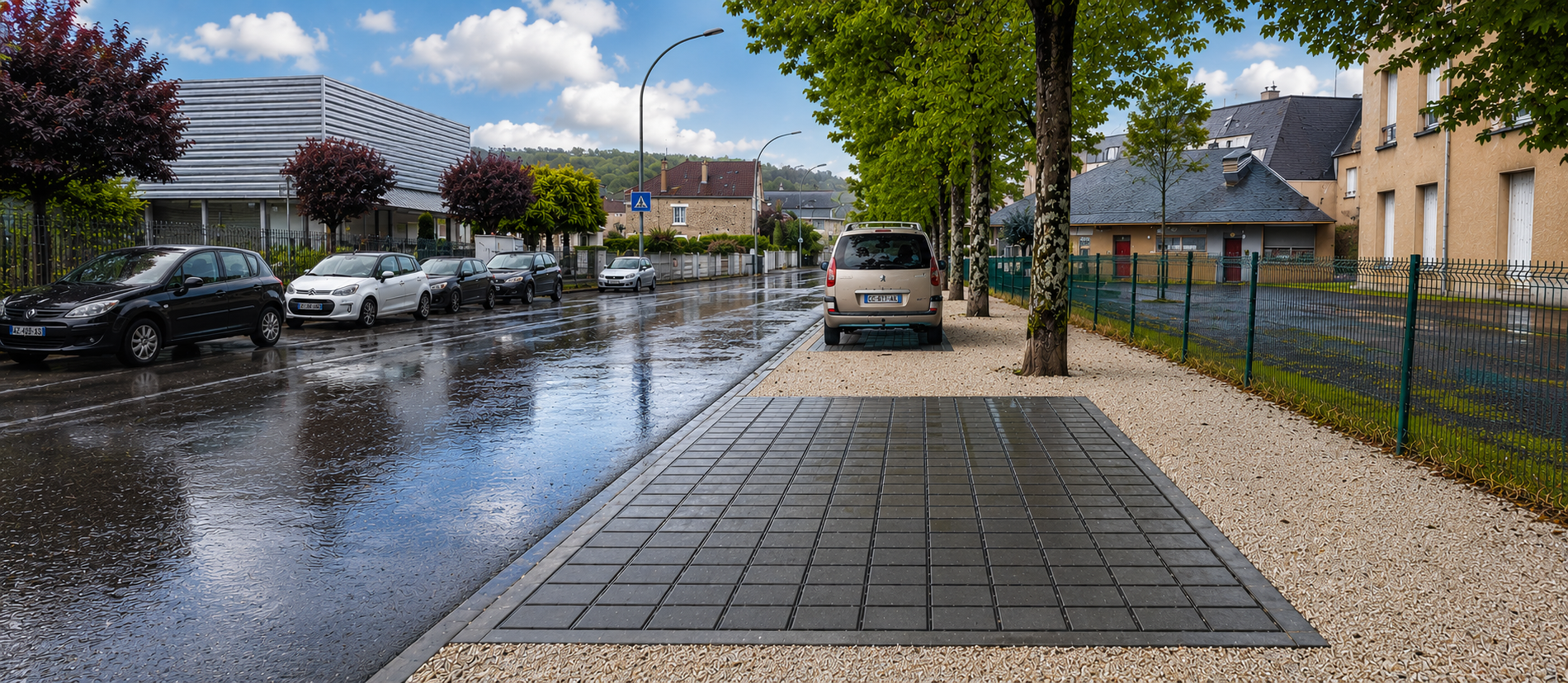
The OCITY PAV65 cellular slab addresses this logic directly: it delivers structural stability and surface permeability simultaneously, with laboratory-measured performance that is independent of joint condition.
Read our article on runoff coefficients for permeable paving
Permeable car parks are relevant across a wide range of project types: council facilities, retail parks, business campuses, residential developments, campsites, natural sites and historic town centres. In each context, hydraulic performance depends on the complete surface build-up — subgrade, draining sub-base, bedding course and paving retention system. The OCITY PAV65 cellular paving slab (Nidaplast Environnement) delivers a measured permeability above 5.33 × 10⁻³ m/s (CERIB protocol 353.E_v2), independent of joint clogging, through a peripheral infiltration system around each paving unit. It accepts concrete or natural stone paving units and allows differentiated bay zoning (disabled, family, EV charging) through paver colour selection. Manufactured in Europe from 100% recycled and recyclable post-consumer LDPE.