Sustainable stormwater management in an urban environment
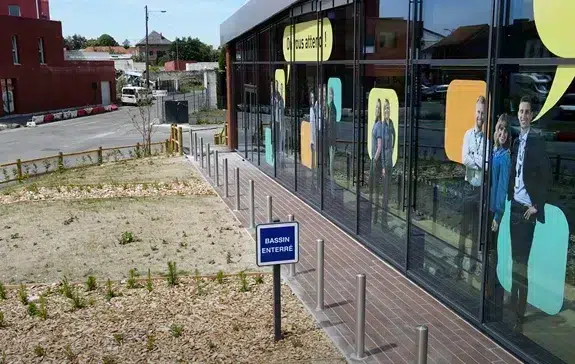
Discover how Nidaplast EP modules made it possible to build a high-performance underground retention basin for the new LIDL store in Vieux-Condé (North of France).
An efficient solution for managing stormwater while meeting spatial constraints and maintaining traffic flow in a dense urban setting.
Project Context and Challenges
Reducing runoff and avoiding overload of the stormwater network
With increasing urbanisation and decreasing permeable surfaces, an underground retention basin was necessary to collect stormwater runoff from the car park and the LIDL roof.
Identified constraints:
- Restricted working area close to a road
- Short construction schedule before the store opening
Objectives Defined by the Project Owner
The specifications required the installation of a fully underground retention basin ensuring:
- temporary stormwater storage,
- controlled discharge to the sewer network,
- a durable solution compliant with French ALUR requirements. (Note: Adapt accordingly for international audiences.)
Solution Implemented with Nidaplast
Nidaplast EP modules – honeycomb structures for water storage
Nidaplast EP modules were selected for their hydraulic performance, high mechanical strength and ease of installation.
Advantages in this context:
- 95% useful void volume → maximum storage in limited space
- Lightweight & easy to handle → fast installation without heavy machinery
- Recyclable product manufactured in France
Technical Characteristics of the Installed Product
Maximum allowable cover height:
Installation Process
Before any underground structure installation, our Design & Engineering Department provides technical drawings and a layout plan specific to the project.
1. Excavation
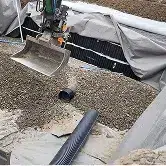
Excavation of the retention area with a minimum 50 cm safety perimeter for proper geotextile wrapping.
2. Bedding layer
Creation of the basin envelope using a 300 g/m² geotextile covering the entire structure.
A gravel bedding layer is installed on top of the geotextile.
3. Diffusion network
Upstream and downstream inspection chambers are connected by an external diffusion channel:
a perforated drain (2/3 perforated on top) installed in a granular bed beneath the honeycomb modules.
4. Laying the modules
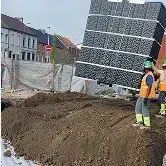
Installation of the Nidaplast EP blocks according to the approved layout plan.
On this project, the retention basin consisted of three layers of EP modules.
Average installation rate: 100 m³ per worker per day.
5. Ventilation and basin closure
A ventilation system is placed on the top layer to allow air release and proper filling of the modules.
The geotextile sheets are then folded over the top of the structure.
The basin is backfilled laterally, then covered and compacted in successive layers to allow construction equipment to circulate safely.
Results and Benefits Observed
Optimal stormwater management without surface ponding
Reduced flood risk and protection of the downstream sewer network
Invisible, fully buried infrastructure
Fast installation and time savings on site
Durable structure compliant with regulatory requirements
“The Nidaplast EP system proved to be the best solution to combine hydraulic performance with fast installation. An ideal choice for urban civil engineering and stormwater management projects.”