When designing a permeable parking lot, attention is often focused on the surface pavement.
However, the long-term performance of the system depends primarily on the quality of its foundation structure.
An improperly designed foundation can lead to differential settlement, surface deformation, reduced infiltration performance and premature deterioration of the installation.
For consulting engineers, civil engineering professionals and project managers, the design of a permeable parking foundation must achieve two key objectives:
- ensure adequate load-bearing capacity throughout the service life of the structure;
- provide effective stormwater management as close as possible to the point of rainfall.
Permeable car park foundation: 4 key principles
Subgrade: assess the nature of the ground, its bearing capacity, permeability and the hydrogeological context before defining the pavement structure.
Bearing capacity: design the foundation according to the expected traffic and loads to limit settlement and deformation of the pavement.
Water management: design a structure capable of draining and, depending on the project, temporarily storing or infiltrating rainwater.
Structure: size the capping layer and foundation according to the ground conditions, mechanical loads and the selected permeable surface.
Step 1: Assess the Existing Ground Conditions Before Design
Before defining layer thicknesses or selecting foundation materials, it is essential to accurately characterize the existing ground conditions. The quality of the subgrade directly influences structural stability, drainage performance and long-term behavior under traffic loads.
A geotechnical investigation helps determine:
- soil composition;
- moisture sensitivity;
- bearing capacity;
- natural permeability.
These parameters form the basis of the design process and are critical to ensuring the long-term performance and durability of a permeable parking system.
Verify the Soil Infiltration Capacity
Natural infiltration is one of the fundamental principles of permeable surface design. The soil’s ability to absorb water is generally expressed by the permeability coefficient (K-value), which indicates the rate at which water can infiltrate the ground.
Beyond soil permeability alone, the preliminary site assessment should also consider the site’s hydrogeological conditions. Groundwater depth, the presence of low-permeability soil layers and site topography can all influence infiltration capacity and foundation design decisions. These parameters help determine the feasibility of source-control infiltration strategies and identify potential hydraulic constraints at an early stage of the project.
Depending on site conditions, several approaches may be considered, including direct infiltration into the subgrade, progressive infiltration through the soil profile, or controlled discharge to an outlet where geotechnical conditions require it.
This assessment plays a crucial role in modern sustainable stormwater management strategies, including Sustainable Urban Drainage Systems (SuDS), Low Impact Development (LID) practices and policies aimed at reducing soil sealing and preserving natural infiltration processes.
It helps determine whether the existing soil can naturally absorb infiltrated runoff or whether additional drainage measures are required.
In practice, when subgrade permeability is sufficiently high (K > 10⁻⁶ m/s), infiltration can generally occur directly into the natural ground. For less permeable soils (K between 10⁻⁷ and 10⁻¹¹ m/s), the use of a diffuser drain is recommended to improve water dispersion and maintain long-term drainage performance.
Soil Permeability K (m/s)
10 to 10⁻⁶
10⁻⁷ to 10⁻¹¹
Recommendation
No diffuser drain required
Diffuser drain recommended
Considering the Contributing Drainage Area During Project Design
The design of a permeable foundation should not be limited to the parking area alone. In many projects, the system may also receive stormwater runoff from adjacent areas such as access roads, pedestrian walkways or other impermeable surfaces connected to the drainage scheme.
Together, these surfaces form the project’s contributing drainage area, meaning the total catchment area from which rainwater is directed towards the permeable structure. The larger the contributing area, the greater the volume of water that the foundation may be required to infiltrate.
This parameter should be evaluated during the early design stages to ensure consistency between the soil’s infiltration capacity, the expected hydraulic performance of the system and the volume of stormwater to be managed. Underestimating the contributing drainage area can lead to temporary saturation of the structure during intense rainfall events and may compromise the long-term performance of the installation.

Step 2: Define the Load-Bearing Requirements
The foundation structure must be designed according to the actual loads the parking area will experience throughout its service life.
Mechanical stresses vary considerably depending on traffic conditions, whether the facility is intended for passenger vehicles, office developments, commercial premises, logistics areas, service vehicles or emergency access routes.
Underestimating traffic loads is one of the most common causes of premature deformation and structural failure in permeable pavement systems.
Indicative bearing capacity targets measured through plate load testing may vary depending on the intended application:
Indicative bearing capacity targets measured through plate load testing may vary depending on the intended application:
Application Type
Residential or office parking (light vehicles)
High-use commercial parking
Utility vehicle parking
Logistics areas or heavy vehicle traffic
Emergency access roads / fire lanes
Indicative EV2 Bearing Capacity
≥ 50 MPa
≥ 60 to 80 MPa
≥ 80 to 120 MPa
≥ 120 MPa
≥ 120 to 150 MPa
These values are provided for guidance only and should always be validated through a geotechnical assessment and project-specific engineering requirements. Final design criteria depend on subgrade conditions, applied loads and the selected pavement structure.
Understanding Plate Load Tests and EV1 / EV2 Moduli
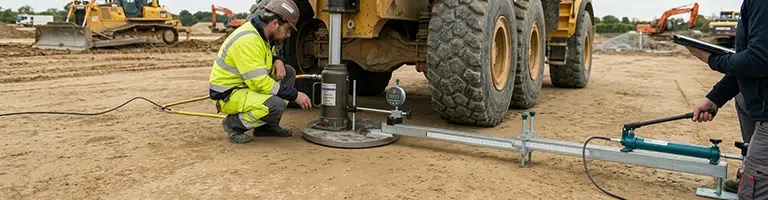
Before foundation layers are installed, platform bearing capacity is commonly verified using a plate load test, a standard procedure widely used in earthworks and pavement construction.
The test consists of applying successive loading cycles to a circular steel plate resting on the soil surface and measuring the resulting deformation. The objective is to assess the ability of the ground to withstand future loads without excessive settlement.
The test provides two key indicators:
- EV1, representing the soil response during the first loading cycle;
- EV2, measured during the second loading cycle and reflecting the effective bearing capacity after compaction.
In practice, the EV2 modulus is the most commonly used parameter for validating platform quality before the installation of upper structural layers.
The EV2/EV1 ratio is also an important indicator. Excessively high values may reveal insufficient compaction or heterogeneous ground conditions, whereas a controlled ratio generally indicates a properly prepared platform.
For permeable parking projects, these tests help verify that the supporting structure will withstand operational loads while maintaining long-term performance.
Step 3: Design a Structural and Draining Foundation
The foundation structure performs a dual function: it transfers loads to the natural ground while supporting stormwater management through its drainage and temporary water storage capacity. Its design must therefore balance structural performance with hydraulic efficiency.
The Role of the Formation Layer
The formation layer provides the interface between the natural ground and the foundation layers.
Its functions include:
- creating a uniform support platform;
- improving bearing capacity;
- reducing the risk of localized settlement;
- preparing the surface for the installation of upper layers.
Depending on site conditions, this layer may require specific adaptations identified through the geotechnical assessment.
In some projects, the formation layer can also compensate for limitations in the natural ground when the existing subgrade does not provide the required bearing capacity or infiltration performance for the intended application. In such cases, it acts as a critical interface between the subgrade and the foundation structure, contributing both to the long-term stability of the pavement and to its hydraulic performance.
How Should Foundation Thickness Be Determined?
There is no universal thickness suitable for every project.
Foundation design depends on several factors, including:
- subgrade bearing capacity;
- expected traffic levels;
- concentrated loads.
Each project requires a dedicated engineering assessment to ensure long-term durability and performance.

Adapting the Foundation to the Final Surface Finish
Foundation design is influenced not only by traffic loads and subgrade conditions but also by the type of permeable surface selected and the performance requirements of the project.
For mineral-based parking areas, the primary function of the foundation is to provide structural support and ensure efficient stormwater drainage. Vegetated areas, however, introduce additional design considerations. In these applications, the foundation must support plant growth while maintaining its structural and hydraulic performance over time.
Foundations intended for grassed or landscaped surfaces may therefore incorporate specific materials, such as soil-aggregate blends, which combine water permeability, load-bearing capacity and the conditions necessary for healthy root development.
Regardless of the solution chosen, foundation layers should be carefully levelled and their bearing capacity verified before the installation of the final surface. This step helps ensure uniform performance across the entire parking area and reduces the risk of differential settlement over the long term.
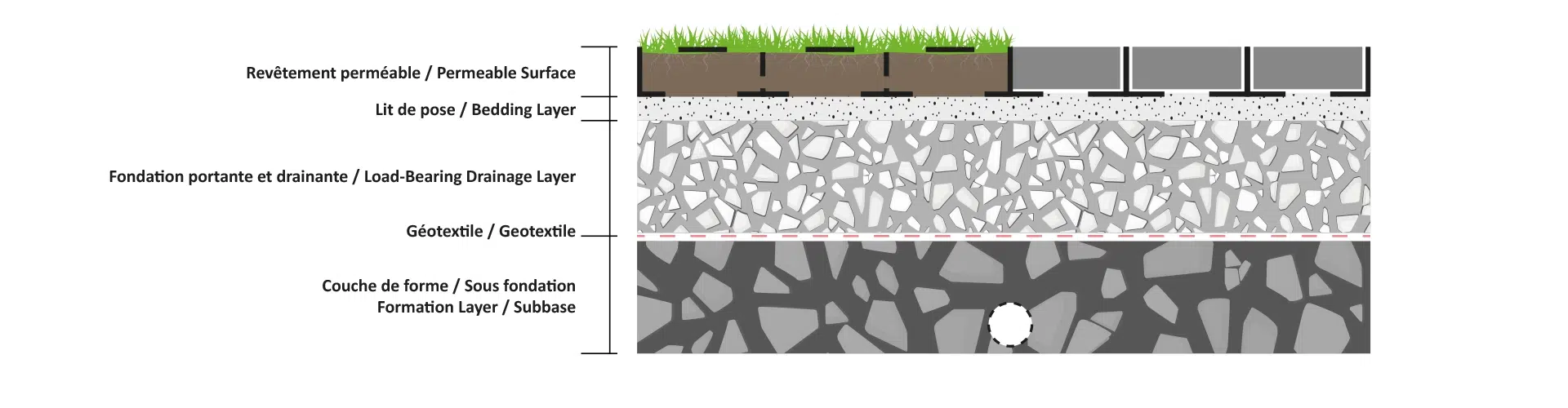
Figure 1 – Example of a permeable parking foundation structure. The composition and thickness of each layer should be adapted to the specific project requirements and validated through a geotechnical assessment.

Slab PAV65
The Ocity PAV65 slab is specifically designed for installing 15 × 15 × 6 cm pavers. Its structure ensures perfect alignment and excellent mechanical strength. Ideal for car parks, driveways, and trafficable areas, it facilitates the creation of durable and permeable surfaces.
View product sheet
Slab NGR65
The Ocity slab stabilizes both gravel and grassed surfaces while preserving soil permeability. Its honeycomb structure provides excellent mechanical strength and ensures a stable, driveable surface as well as deep grass rooting. Ideal for urban landscaping, it combines functionality, drainage, and long-lasting aesthetics.
View product sheetMost Common Design Mistakes
Even when high-performance permeable paving systems are used, certain design errors can compromise the overall effectiveness of the parking lot.
Neglecting Subgrade Quality
Insufficient ground investigation can result in differential settlement and long-term structural issues.
Undersizing the Foundation
Reducing foundation thicknesses to lower construction costs often leads to a shorter service life.
Using Poorly Draining Materials
A foundation that becomes clogged over time gradually loses its hydraulic performance. Material selection is therefore a critical aspect of the design process.
Confusing Bearing Capacity with Excessive Compaction
Over-compaction can reduce permeability within certain layers and negatively affect infiltration performance. The objective is to achieve the right balance between structural stability and hydraulic functionality.
Integrating Regulatory and Environmental Requirements from the Start
Today, parking lot design extends beyond traffic management alone. Project owners and developers must also address runoff control, source-control stormwater management and soil preservation objectives.
Across many countries, planning authorities increasingly encourage sustainable drainage practices, the reduction of impervious surfaces and the preservation of natural hydrological processes. These policies are often aligned with broader environmental goals such as reducing land take, limiting soil sealing and promoting climate-resilient urban development.
Permeable parking systems contribute directly to these objectives by promoting natural infiltration and reducing dependence on conventional drainage infrastructure.
A properly designed foundation therefore plays a key role in meeting both hydraulic and environmental performance targets established by local planning authorities and sustainability frameworks.
Summary
The success of a permeable parking lot begins long before the pavement is installed.
A high-performing foundation relies on four essential principles:
- accurately assessing subgrade conditions;
- verifying bearing capacity through appropriate testing;
- correctly designing foundation layers;
- maintaining long-term hydraulic performance.
This approach helps combine structural durability, source-control stormwater management and compliance with modern sustainable development objectives.

Technical Appendix – Glossary
Term
EV1
EV2
Granular Subbase
Formation Layer
K-Value
SuDS
LID
Soil Sealing
Definition
Modulus measured during the first loading cycle of a plate load test
Modulus measured during the second loading cycle of a plate load test
Unbound aggregate layer used to distribute loads and provide drainage
Prepared surface forming the interface between natural ground and pavement structure
Soil permeability coefficient expressed in m/s
Sustainable Urban Drainage Systems
Low Impact Development stormwater management approach
The covering of natural soil with impermeable materials, reducing infiltration capacity