


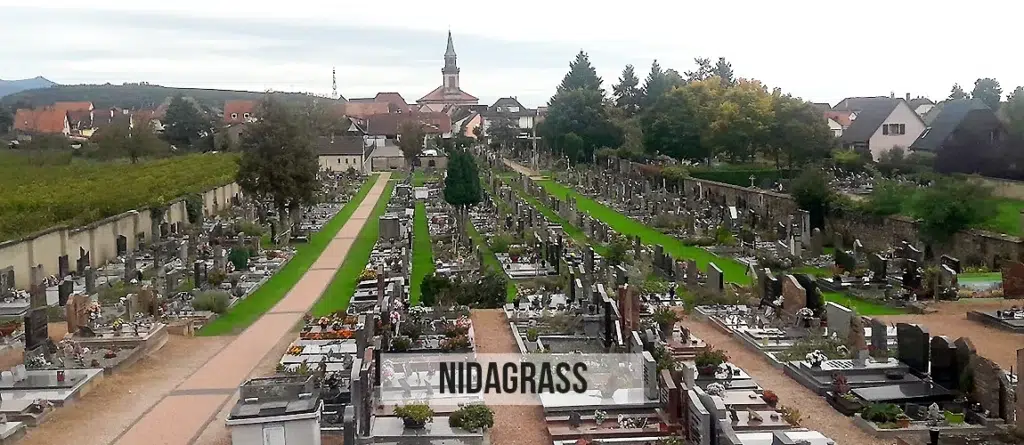
Grass reinforced, permeable and durable cemetery access roads
At the municipal cemetery in Westhalten, Alsace, the internal pathways and access roads were upgraded to combine accessibility, long-term durability and seamless landscape integration.
Across a total surface area of 350 m², Nidagrass NG040 and OCITY NGR65 grass reinforcement grids were installed to create stable, vegetated and load-bearing pathways specifically designed to meet the operational requirements of a cemetery environment.
This project addresses concrete challenges faced by many local authorities: demanding maintenance constraints, surface degradation caused by occasional vehicle traffic, and increasing environmental regulatory requirements.
350 m²
main access pathway
100%
permeable surface
2024
year of completion
Project context and key challenges
Why vegetate cemetery pathways?
Local authorities are now subject to stricter regulations prohibiting the use of phytosanitary products for cemetery maintenance.
As a result, manual maintenance of pathways has become more complex and time-consuming, while staffing and budget resources remain limited.
Furthermore, cemetery rehabilitation represents a significant financial investment. Traditional solutions such as mineral or impermeable surfacing systems often prove costly both in terms of installation and ongoing maintenance.
Elected officials must therefore prioritise solutions that are cost-effective, durable and straightforward to implement.
Cemetery pathways must also remain load-bearing to accommodate occasional traffic from technical services and funeral vehicles. Depending on weather conditions and the existing surface (gravel or non-stabilised grass), vehicle movements can lead to rutting, compaction or muddy areas, making access and interventions difficult.
In this context, environmental objectives related to urban de-sealing and renaturation also apply to cemeteries.
The selected solutions must enable full rainwater infiltration while integrating sustainably into the municipality’s green infrastructure network.
Project objectives for the local authority
The client’s brief defined several clear objectives:
Reduce installation costs through a fast and easy-to-install solution
Achieve aesthetic, uniform and durable grassed pathways, including around monuments
Ensure robust, load-bearing access routes for funeral service vehicles
Improve ground bearing capacity to prevent rutting and settlement caused by vehicle traffic
Achieve long-term reductions in cemetery maintenance time and costs

A load-bearing grass pathway solution with Nidagrass grids
The selected solution consists of installing Nidagrass NG040 and OCITY NGR65 cellular grass reinforcement grids combined with turfing to deliver a stable, functional and fully vegetated surface system.
Technical specifications of the installed system
Panel dimensions:
500 x 500 mm.
Cell depth:
40 mm.
Permeability:
100 % permeable.
Material:
100% recycled and recyclable polypropylene

Cellular grids engineered for public sector applications
Manufactured in France from recycled polyethylene, Nidagrass grids are 100% recycled, 100% permeable and 100% recyclable.
They are specifically engineered to stabilise grassed surfaces while withstanding occasional mechanical loads.
Their cellular structure provides:
Even load distribution, limiting rut formation
Direct rainwater infiltration, without runoff or standing water
A continuous, aesthetic vegetative cover
Fast installation thanks to lightweight, pre-assembled and easily cut panels
Pathway maintenance is significantly simplified: the grass is mown like a conventional landscaped area, reducing intervention time by a factor of five to seven compared to traditionally maintained cemeteries requiring manual upkeep.

Slab NG040
The nidagrass NG040 grass slabs are low-density recycled polyethylene (LDPE) panels designed to be grass-filled. They were specifically developed to provide a stable and driveable grass surface, preventing the formation of ruts, depressions, or puddles.
View product sheetInstallation process
The project was carried out in three stages:
1. Subgrade preparation
Earthworks and compaction of the formation layer.
2. Installation of Nidagrass Grids

The Nidagrass NG040 grids, with a thickness of 40 mm, feature reinforced thick edges.
They interlock securely and can be cut on site to accommodate project constraints and layout requirements.
3. Infill and turf establishment by hydromulching
Following the installation of the Nidagrass NG040 grids, infill and grass seeding were carried out using hydromulching.
This technique consists of spraying directly into the cells a mixture composed of water, plant-based fibres, grass seed and, depending on site requirements, fertilisers or binding agents.
The mixture is tailored to the specific characteristics of the project and local conditions.
When applied in cemeteries, hydromulching enables rapid vegetation of load-bearing grass grids without heavy works, including in narrow areas, corners and around monuments.
This method ensures homogeneous filling of the grids, promotes rapid grass germination and contributes to the long-term durability of the reinforced grass surface.
4. Maintenance of reinforced grass pathways
The pathways are mown in the same way as conventional turf.
During hot and dry periods, temporary yellowing may occur, particularly near monuments. This is a natural and reversible phenomenon: the grass regains its green appearance once favourable weather conditions return.
Prolonged vehicle parking on grass-reinforced pathways should be avoided in order to ensure healthy and consistent vegetative cover development.


