


For more than 40 years, Nidaplast has been developing innovative solutions based on polypropylene honeycomb cores for composite sandwich structures, used across many industrial sectors including transportation, construction, marine and technical equipment.
At JEC World 2026, the leading international event for the composites industry, Nidaplast will present an innovation that illustrates key market trends: structural lightweighting, recyclable materials and the integration of natural fibers.
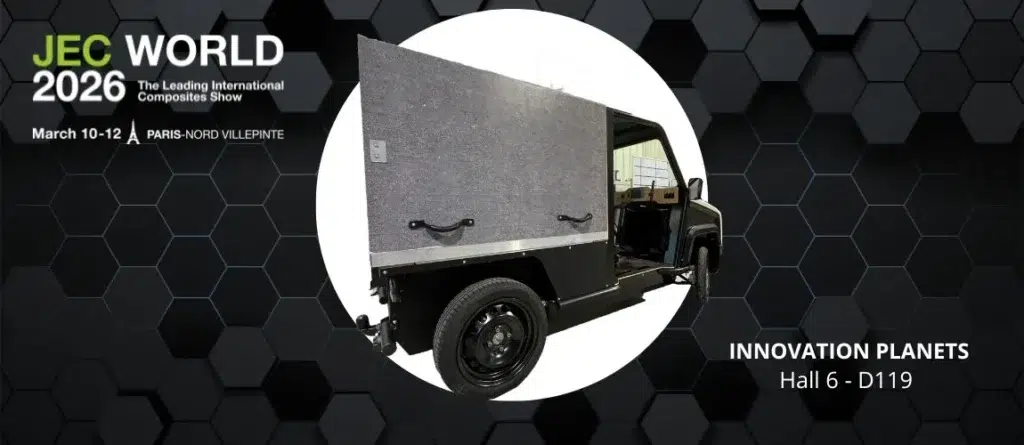
This innovation will be showcased within the Innovation Planets area (Automotive & Road Transportation) through the Midipile project, a hybrid logistics vehicle whose body integrates an ultra-lightweight composite sandwich panel developed by Nidaplast.
A composite innovation for low-carbon urban logistics
The Midipile project addresses a clear need in last-mile logistics: transporting goods efficiently in urban environments while reducing the carbon footprint.
The vehicle, positioned between a cargo bike and a light utility vehicle, is designed to carry up to 300 kg of payload, equivalent to a European pallet, with an electric range of 60 to 80 km.
To achieve this objective, weight reduction was a key innovation driver.
The vehicle’s cargo box is manufactured from an ultra-lightweight composite sandwich panel weighing only 4 kg/m², combining:
a partially recycled polypropylene honeycomb core
composite skins made from natural fibers (flax and hemp) combined with recycled polypropylene fibers supplied by Eco-Technilin, a specialist in natural fiber composite reinforcements.
This material offers a credible alternative to fiberglass, while improving the overall carbon footprint of the structure.

The role of Nidaplast sandwich panels in vehicle lightweighting
Composite sandwich structures are now widely used to design lightweight and high-strength structures in transportation applications.
The principle is simple:
a lightweight core (such as a polypropylene honeycomb) separates two rigid skins, significantly increasing structural stiffness while minimizing weight.
Thanks to this architecture, Nidaplast panels offer:
- an excellent stiffness-to-weight ratio
- high compressive and shear strength
- effective vibration and noise damping
- strong resistance to water and aggressive environments
These properties make them a preferred solution for structural lightweighting in automotive, railway, marine and industrial sectors.

A design optimized for manufacturing and use
The Midipile cargo box illustrates a new approach to composite body design.
Instead of assembling multiple sandwich panels reinforced with heavy metal profiles, the structure relies on only two machined and folded thermoplastic composite panels:
one panel forming the floor and rear wall
one panel forming the roof and side walls
Machining offcuts are fully reused to manufacture the door.
This approach allows:
- a significant reduction in the number of parts
- limited use of metal reinforcements
- optimized material efficiency
- simplified and faster assembly in the workshop
The entire structure is assembled using polyurethane adhesive bonding, ensuring excellent adhesion between the composite panels.
Natural fibers and composites: a low-carbon alternative
The use of flax and hemp fibers is one of the most innovative aspects of the project.
Unlike glass fibers, whose production generates CO₂ emissions, plant fibers offer a major environmental advantage: they absorb CO₂ during their growth cycle.
Combined with a recyclable polypropylene honeycomb core and recycled thermoplastic fibers, they make it possible to design a more sustainable composite panel with reduced environmental impact.
A design approach focused on composite recyclability
The end-of-life management of composite materials has become a key concern for manufacturers.
In the Midipile project, recyclability was integrated from the design phase.
After removing the few metallic inserts, the cargo box can be fully recycled through:
- grinding of the composite material
- reuse in the production of new composite skins
- or reintegration into injected thermoplastic parts
This circular design approach (developed in collaboration with Novamotum, an engineering consultancy specialized in bio-based composites and functional materials) reduces material losses and facilitates the recovery of components at end of life.


Discover this composite innovation at JEC World 2026
This innovation will be presented at JEC World 2026, the leading international composites trade show, taking place in Paris from March 10 to 12.
Meet Nidaplast at:
Hall 5 – Stand Q74
The Midipile vehicle will be displayed in the Innovation Planets area – Automotive & Road Transportation.
This event will provide an opportunity to discuss with the Nidaplast team about next-generation composite sandwich panels, bio-based materials and lightweighting solutions for industry.
Project partners
Nidaplast contributed to this project with the support of:
- Midipile : Manufacturer of the active hybrid low-carbon vehicle
- Eco-Technilin : Expert in natural fiber composite reinforcement solutions
- Novamotum : Technological partner of the Midipile project
“The selection of this vehicle for the Innovation Planets area at JEC World recognizes the commitment of all project partners and the teamwork carried out over the past months. We hope that the integration of these new environmentally friendly materials will inspire other manufacturers and composite processors.”
— Damien Faudot - Export Manager Nidaplast

